
"In seafaring and in science — or both, in the case of Schmidt Ocean — preparation and boldness can turn chance into discovery."
- Wendy Schmidt, Co-Founder and President, Schmidt Ocean Institute
A word from our founders
What does Falkor — the wise luckdragon from Michael Ende’s “The Neverending Story” and the namesake of Schmidt Ocean Institute’s research vessel — have in common with famed French scientist Louis Pasteur?
They both understood that to be lucky, you have to be ready.
For Falkor, this meant diving deep into the sea at great personal risk to recover an amulet and rescue a friend.
For Pasteur, it meant realizing that a failed experiment on cholera contained a key insight: an injection of a weakened pathogen could create immunity to the full-strength illness, an essential realization toward the development of vaccines. As Pasteur himself put it, “Chance favors only the prepared mind.”
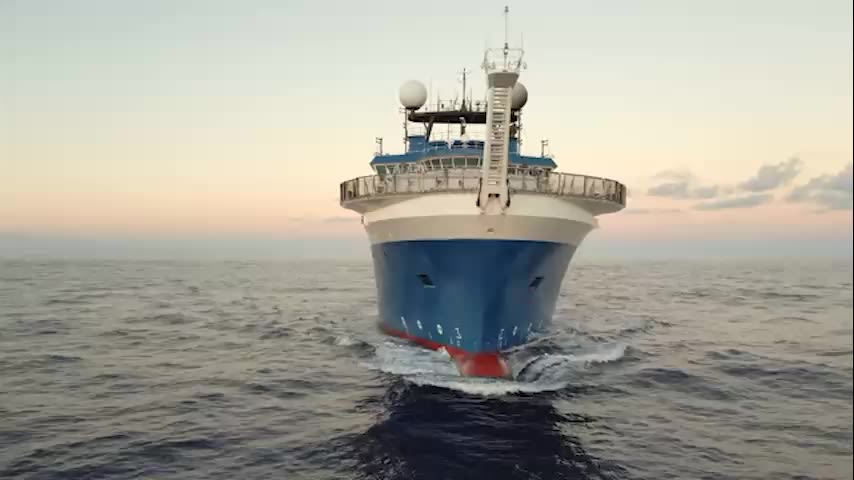
In seafaring and in science — or both, in the case of Schmidt Ocean — preparation and boldness can turn chance into discovery. We learned that lesson repeatedly throughout this epic year. In January, when an iceberg the size of Chicago cleaved from the Antarctic coast, R/V Falkor (too), a certified Ice Class-C vessel, changed course to explore the newly revealed expanse of Ocean — a first for humanity. During the next expedition, scientists captured the first footage of a living colossal squid, a mesmerizing, translucent juvenile, after a century of encountering them mostly as remains in predators’ stomachs.
A few months later, luck came again in the form of charismatic sea creatures spotted off the coast of Argentina — thanks to the dedication of Argentine scientists who had been studying them for decades without ever having seen them in their natural habitats. One of these sea creatures happened to resemble a beloved cartoon starfish, captivating a nation in a viral moment that perfectly married luck and preparation.
And in preparation for future luck, Schmidt Ocean Institute welcomed aboard several new technologies, including an autonomous underwater vehicle (AUV) The Childlike Empress. It is named after another Neverending Story character, the leader of the book’s fantastical world. Her role in the story is not only to rule that world, but also to keep it from sinking into what characters fearfully call The Nothing.
“The Nothing” is a good term, too, for how the deep sea might appear if it went unexplored. If we didn’t have the power to imagine, seek, and discover. Thanks to our AUV, our many other technologies, scores of dedicated scientists, crewmembers, and staff, we’ll always keep looking.
We’ll always prepare for luck.
|
|
|
Eric and Wendy Schmidt
A note from our Executive Director
What a luminous year it has been for the South Atlantic Ocean! In 2025, Schmidt Ocean Institute staff and crew, and scientists from 21 countries ventured deep into the South Atlantic Ocean on board R/V Falkor (too) — into a realm full of secrets waiting to be unlocked. Together, we discovered new species and breathtaking seafloor landscapes, completed the most comprehensive modern survey in Uruguayan waters, answered questions about how submarine canyons and currents influence Argentina’s renowned marine life, and flirted with the origins of complex cellular life. We’re excited to share these scientific journeys with you in Chapter 2, Expedition Logbook.
Nature, as always, enchanted us with serendipitous surprises — from a spontaneous encounter with a delicate, tiny squid to a timely and unprecedented opportunity to explore pristine Antarctic waters previously locked beneath centuries of ice. Though unscripted, these monumental moments captured hearts and imaginations worldwide, allowing us to amplify the Ocean in unexpected ways. Behind the scenes, we moved with bold intention to fundamentally enhance our research capabilities through two key improvements: redesigning and altering the bow of R/V Falkor (too) and welcoming The Childlike Empress, our state-of-the-art autonomous underwater vehicle (AUV). Both elevate our mapping capabilities — a fitting milestone in a year when Schmidt Ocean Institute surpassed 2 million square kilometers of seafloor mapped. Every kilometer is now woven into the General Bathymetric Chart of the Ocean (GEBCO), bringing us closer to the aspirational goal of Seabed 2030. These and other events during these whirlwind 12 months are detailed within Chapter 1, Soundings.
R/V Falkor (too) during operations in the Bellingshausen Sea. Alex Ingle / Schmidt Ocean Institute
R/V Falkor (too) during operations in the Bellingshausen Sea. Alex Ingle / Schmidt Ocean Institute
Our partnerships continue to advance and accelerate the impact of the work, and Chapter 3, Currents of Connection, captures this shared journey. Through targeted technology grants for local communities where Falkor (too) is operating and scientific initiatives such as the Ocean Keeling Curve, we are working with many others to advance our understanding of our beautiful blue planet.
This spirit also radiates through Chapter 5, Ripple Effect. Our Artist-at-Sea program — which facilitates collaborations between artists and marine scientists — reached new heights, with major international exhibitions held across five continents. And our Ocean Rising Program, launched in 2021 in partnership with Nekton, brought the wonder of the deep straight into fashion shows, sports arenas, theaters, and lively cultural festivals. Thanks to an outpouring of contagious enthusiasm from audiences in Argentina and beyond, our digital community blossomed, surpassing one million followers, drawn together with a common love for the mysteries revealed during live deep-sea video streams.
As you wander through this report, we hope you feel the joy and dedication that defined our work to amplify the Ocean at sea and on shore in 2025. The Ocean holds endless wonder, and we cannot wait to discover what lies just beyond the next seamount.
Dr. Jyotika Virmani
Dr. Jyotika Virmani
"The Ocean holds endless wonder, and we cannot wait to discover what lies just beyond the next seamount."
- Dr. Jyotika Virmani, Schmidt Ocean Institute Executive Director
 Built with Shorthand